Treves Sans: A Raw Handwritten Display Font
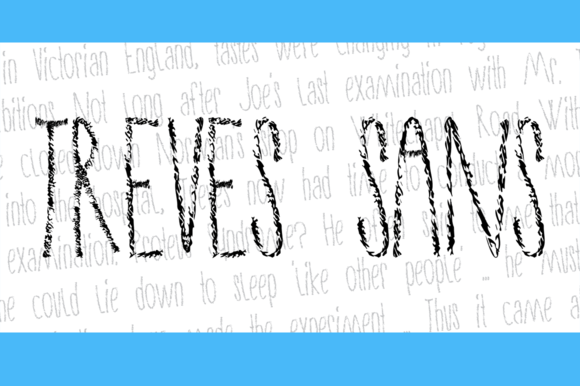
Some typefaces whisper. Treves Sans scratches its way onto the page. This is not a font designed for polite body copy or subtle headers. Treves Sans is a display typeface built from irregular, messy strokes that mimic the texture of charcoal on rough paper or the ghostly impression of a brass rubbing. When inverted or placed on a dark background in lighter tones, it transforms into something that looks like chalk dragged across a slate board. The result is a visual that feels immediate, tactile, and unmistakably human.
For creators and designers who are tired of sterile, vector-perfect fonts, Treves Sans offers a raw alternative. It carries the energy of someone who pressed too hard with a crayon, or the residue left after a rubbing was lifted from a textured surface. That imperfection is its greatest asset. In a digital landscape where everything can feel sanitized, this font brings back the friction of physical mark-making.
What Makes Treves Sans Different from Other Handwritten Fonts
Most handwritten fonts try to simulate neat, consistent penmanship. They smooth out the wobbles and clean up the edges. Treves Sans does the opposite. It embraces irregular line weight, broken strokes, and the kind of rough edges that happen when a blunt tool meets a textured surface. The charcoal and brass rubbing comparison is not a marketing flourish—it is an accurate description of what you see on screen and in print.
The letterforms vary in thickness. Some strokes appear faint, as if the charcoal was running out. Others are dense and heavy, as though the artist pressed down hard to capture a detail. This variation creates a sense of depth and motion. When you look at a word set in Treves Sans, your eye reads both the letter and the texture surrounding it. That dual reading is what makes the font feel alive.
When reversed—white on black or a light pastel on a dark surface—the same strokes read as chalk. The light areas mimic the dusty, irregular deposit that chalk leaves on a rough board. This dual nature gives you two distinct visual personalities from a single typeface. One pass feels like a studio artist's sketch. The inverted version feels like a classroom demonstration or a pub chalkboard menu. Both are useful, and both carry the same underlying rough honesty.
Creative Applications That Play to the Font's Strengths
Treves Sans is not a font you use for a 200-page report. It is a font you use when you want someone to stop and feel something. That makes it ideal for specific kinds of projects where texture and mood matter more than speed-reading efficiency.
Posters and Event Graphics
Music festival posters, art gallery openings, underground film screenings, and independent theatre productions all benefit from the visual grit of Treves Sans. The scratchy strokes suggest something handmade, countercultural, or urgent. A poster for a punk show or a poetry slam set in Treves Sans feels more authentic than the same text in a polished sans-serif. The texture reinforces the message. If the event is raw, unpolished, or DIY, this font carries that tone visually before a single word is read.
Packaging for Artisanal and Small-Batch Products
Small business owners and entrepreneurs who produce handmade goods—soap, ceramics, hot sauce, candles, preserves—can use Treves Sans to signal that the product was made by human hands, not by a machine. A label set in this font tells the customer that the contents are small-batch, imperfect in the best way, and worth trying because someone cared enough to scratch the name onto the label themselves. The chalk version works particularly well on dark kraft paper or matte black packaging.
Social Media and Digital Content
Instagram carousels, YouTube thumbnails, TikTok title cards, and blog headers all compete for attention in a crowded feed. Treves Sans cuts through the noise because it does not look like every other font in the platform's library. A single word set in Treves Sans on a dark background creates a thumbnail that people will pause on. The chalk effect is especially effective for tutorial content, study tips, motivational quotes, or educational posts where you want the text to feel like it was written on a blackboard in real time.
Zines, Comics, and Independent Publishing
Publishers and creators working in zine culture, indie comics, or small-run booklets will find a natural ally in Treves Sans. The font matches the aesthetic of photocopied pages, hand-stapled bindings, and limited distribution. It does not fight the format. Instead, it enhances the DIY authenticity that readers of indie publishing value. Use it for cover titles, section headers, or pull quotes that need to stand out against busy, collaged backgrounds.
How Different Audiences Can Adapt Treves Sans to Their Goals
Not everyone will use this font the same way, and that is the point. A graphic designer working on a branding project has different constraints than a blogger making a header image or an educator preparing a slide deck. Treves Sans accommodates all of them, provided you understand how to adjust your approach for your specific medium and audience.
For Designers and Brand Strategists
If you are building a brand identity around authenticity, craft, or rebellion, Treves Sans can anchor your visual system. Pair it with a clean, neutral sans-serif for body text to create contrast. The rough headline against the smooth body copy tells a story: we are approachable, but we have an edge. Use Treves Sans sparingly—a single word in a logo, a tagline, or a hero section—because its texture is strong and can overwhelm if overused. Keep the surrounding layout simple, with plenty of negative space, so the font's texture has room to breathe.
For Marketers and Small Business Owners
Your goal is conversion, but conversion does not have to be boring. Treves Sans works well in limited-time offers, seasonal promotions, or event announcements where you want to create a sense of immediacy. A "50% Off Today Only" banner set in the chalk version on a dark background reads differently than the same message in Arial. It feels more urgent, more handwritten, more real. Just make sure the text is large enough to remain legible at smaller sizes, because the rough strokes can blur together when scaled down too much.
For Educators and Content Creators
The chalk version of Treves Sans is a natural fit for educational content. Use it for title slides in video lessons, quote cards for social media, or headers in course handouts. The blackboard association primes viewers for learning. They see the chalk-like letters and subconsciously prepare to take notes or pay attention. Keep the text short—single words or short phrases work best—and use high contrast between the font color and the background to maintain clarity.
For Hobbyists and Freelancers Working on Personal Projects
If you are making something for yourself or for a small community—a logo for a local sports team, a poster for a friend's band, a cover for your own poetry collection—Treves Sans gives you professional-looking texture without requiring any design skill. The font does the heavy lifting of creating mood. You just need to type your words, adjust the size, and choose a background color. The results will look intentional and artistic even if you are working in a free online editor.
Practical Tips for Keeping Results Clear and Effective
Treves Sans is a display font, which means it demands certain conditions to perform well. Ignore these constraints and the texture becomes noise. Respect them and the texture becomes art.
- Size matters. Use Treves Sans at 48 points or larger for most applications. Below that threshold, the broken strokes and irregular weights can make letters hard to distinguish. If you need a smaller size, consider using a simpler handwritten font for the small text and save Treves Sans for headers.
- Contrast is your friend. The charcoal version works best on light, textured backgrounds—kraft paper, off-white, light gray. The chalk version demands dark backgrounds—black, navy, charcoal, deep green. Avoid placing Treves Sans on medium-toned backgrounds where the contrast is weak. The texture will get lost.
- Keep copy short. This font is not built for long sentences. Use it for single words, short phrases, or titles. If you need to convey a longer message, use a clean body font and let Treves Sans handle the headline alone.
- Pair with simple fonts. Let Treves Sans be the rough element in your composition. Pair it with a neutral sans-serif like Helvetica, Open Sans, or Montserrat for body copy. Avoid pairing it with other textured or decorative fonts, which can create visual chaos.
- Test in context. Preview Treves Sans at the actual size it will appear in your final product. A font that looks perfect at 100 points on your monitor might look muddy at 24 points on a business card. Always test before you commit.
Exploring Variations and Interpretations
One of the most interesting aspects of Treves Sans is how much it changes depending on color, background, and scale. The same typeface can feel like a charcoal sketch in one context and a chalk drawing in another. That flexibility gives you room to explore different moods without switching fonts.
Try using Treves Sans in a monochromatic palette—black on gray, white on black, or a single accent color on a neutral background. The texture becomes more pronounced when color is restrained. Bright colors can work, but they tend to compete with the roughness of the strokes. If you want a colorful result, try muted or desaturated tones that let the texture remain visible rather than overwhelming it with hue.
Experiment with layering. Place a Treves Sans headline over a photo, but blur the photo slightly so the texture of the font does not fight with the texture of the image. You can also overlay the font on a rough paper texture or a concrete wall photograph to amplify the tactile impression. Just be careful not to overdo it—the font already carries texture, so layering it on top of an aggressively textured background can make the whole composition hard to read.
Why Treves Sans Deserves a Place in Your Font Library
Every designer and content creator needs a go-to font for projects that require a human touch. Treves Sans fills that role without apology. It is not trying to be elegant or neutral. It is trying to feel like someone made it by hand, and it succeeds. For posters, packaging, social media graphics, indie publications, and educational content, this font brings a level of texture and authenticity that polished fonts simply cannot match.
The dual personality of charcoal and chalk makes it even more versatile. You get two distinct visual effects from a single font purchase or download. Use the charcoal version for gritty, urban, or handmade projects. Use the chalk version for educational, nostalgic, or warm-toned content. Both are effective, and both are recognizably the same typeface. That consistency, combined with the raw visual character, is rare in the display font world.
If you are looking for a font that stops the scroll, grabs attention at the poster wall, or makes a product label feel personal, Treves Sans is worth testing. Keep your layouts clean, your copy short, and your contrast high. Let the font do what it does best: bring the texture of the physical world into your digital projects.