Freakshow: A Uniquely Chaotic Display Font for Attention-Grabbing Projects
When a project demands immediate visual impact, a standard typeface often feels inadequate. You might be exploring options that convey disorder, vintage grit, or a playful sense of danger. Freakshow enters this space as a display font built on deliberate unpredictability. Its design draws from old newspapers, fragmented ransom notes, and a collision of script, eroded, medieval, and vintage styles with modern character forms. This article provides an objective evaluation of Freakshow, outlining its strengths, limitations, and the situations where it could be a strong fit for your work.
What Freakshow Offers: A Overview of Its Character
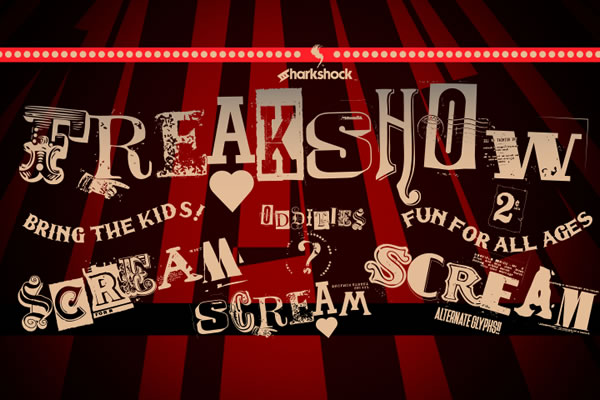
Freakshow is not a typeface for body text or clarity. It is a whimsical kaleidoscope of lettering where each glyph feels as if it has been torn from a different source and reassembled. The creator took inspiration from decades-old advertisements and publications, emulating individual letters and graphics to produce a font that appears both familiar and jarring. The result is a set of characters that mix script flourishes, eroded edges, medieval serifs, and vintage forms alongside more contemporary shapes. The overall effect is haphazard—intentionally so. The font’s likeness is meant to shock, to spill popcorn in awe, and to center stage a poster or headline with a ticket to the freak show.
Technically, Freakshow includes only basic Latin characters and basic punctuation. It is not a comprehensive global font. However, the font does offer bonus alternates if your design program supports OpenType features (OTF). The designer recommends experimenting with uppercase and lowercase combinations to avoid letter repetition, which can enhance the chaotic, varied look the font is built to deliver. For projects where every letter should feel like a unique artifact, this flexibility is a significant asset.
Why Consider Freakshow? Reasons for Interest
You might be interested in Freakshow if your project demands a raw, distressed, or intentionally messy aesthetic. The font’s primary appeal is its ability to stop a viewer and hold attention through visual noise. Here are specific reasons it may resonate:
- Distinctiveness: In a crowded design landscape, many fonts look similar. Freakshow’s collision of styles creates a one-of-a-kind appearance that is difficult to replicate. It signals that the designer is not afraid to break conventions.
- Narrative quality: The font tells a story of decay, mystery, and history. Each letter carries the patina of old print, as if unearthed from a dusty archive. For projects themed around circuses, carnivals, horror, vintage subcultures, or guerrilla marketing, this narrative layer adds depth.
- Flexibility through alternates: The bonus alternates (via OTF features) allow you to swap out repetitive letters, making the font suitable for longer headlines without immediate visual fatigue. This is a practical benefit for poster design where a single word set in all capitals might otherwise look too uniform.
Benefits and Practical Strengths
Beyond its aesthetic, Freakshow offers practical advantages for specific use cases:
- Instant mood setting: Because the font already looks distressed and chaotic, you can skip many of the post-processing steps (e.g., adding grain, erosion, or texture) that other fonts require to achieve a similar feel. This can save production time.
- Scale handling: The font is designed for display sizes—large headlines, titles, and short phrases. At larger sizes, the details in the eroded edges and mixed styles become clearly visible, maximizing impact. At smaller sizes (especially below 24pt), readability drops quickly, but that is not the font’s intended use.
- Retro character: For projects aiming to evoke a late 19th or early 20th century circus poster or an underground zine, Freakshow provides an authentic patina without requiring manual lettering or extensive experimentation.
Tradeoffs, Considerations, and Limitations
When evaluating Freakshow for your project, be aware of several important tradeoffs:
- Limited character set: Only basic Latin letters and punctuation are included. If your project requires accented characters, extended punctuation, or non-Latin scripts, Freakshow will not serve you. This restricts its use to English-language (or similar) audiences.
- Legibility concerns: The font is intentionally hard to read in long stretches. Using it for body text, captions, or any content where clarity is essential will frustrate readers. Even for headlines, the mix of styles can cause confusion if the audience is not primed for a chaotic look.
- Contextual mismatch: Freakshow is not a universal tool. In corporate, medical, educational, or formal contexts, it will look out of place and potentially unprofessional. A bank’s annual report or a hospital’s signage would not benefit from this typeface.
- Potential for visual fatigue: The inconsistent weight, shape, and erosion across letters can feel overwhelming if used too broadly. A single poster with a Freakshow headline may work; a multi-page brochure set entirely in this font would likely fail.
- No language support: The absence of extended characters (e.g., ñ, ü, ç) means that even common words in European languages may be impossible to typeset correctly.
Scenarios Where Freakshow Excels
Freakshow is most effective when its chaotic, vintage-damaged look aligns with the project’s core message. Consider these strong fits:
- Event posters for horror films, haunted houses, or Halloween parties: The font’s eerie, torn-paper aesthetic supports the theme without extra effort.
- Circus, carnival, or freak show themed events: As the name implies, Freakshow is a natural choice for any project that wants to evoke a sideshow atmosphere. It can be used for ticket designs, banners, and promotional materials.
- Album art for genres like punk, industrial, metal, or experimental music: The raw, unpolished look resonates with subcultures that value authenticity and rebellion.
- Retro or vintage advertisements for products that market nostalgia: If you are designing an ad for a craft soda or a vintage clothing line, Freakshow can lend an antique air.
- Ransom note or mystery-themed designs: The name itself suggests a ransom note style. It works well for whodunit party invitations or escape room branding.
- Short slogans and logotypes: For a brand name or tagline where every letter should be a visual curiosity, the alternates allow you to create a logotype that looks like each letter was sourced from a different sign.
Scenarios Where Alternatives May Be Worth Considering
There are situations where a different font could better serve your goals. Here are a few:
- If you need extended language support: Consider other distressed display fonts like Creepster, Nosifer, or Bloody (which may offer more glyphs). For vintage American circus styles, Western typefaces or Circus fonts could be more comprehensive.
- If readability is still somewhat important: A font like GrutchShaded or Schizotype offers distressed character but with more consistent letterforms. Alternatively, a vintage serif with added texture might provide a better balance.
- If you want a similar effect without the fragmentation: Some fonts like Vintage Typewriter or Old Newspaper achieve a worn look without mixing multiple historical styles. This can be preferable if you want a more uniform aesthetic.
- If you need to use the font for longer headlines or subheadings: A clean display font paired with a distressed texture overlay can give you more control over legibility. You can apply wear selectively rather than being locked into a fully chaotic typeface.
- If your project must feel polished or elegant: For high-end branding, museum exhibits, or luxury goods, Freakshow will clash. Instead, opt for a refined vintage serif like Edith or Refinery.
Practical Decision-Making Insights
To determine whether Freakshow aligns with your goals, use the following considerations:
- Define your audience: Will they appreciate a chaotic, demanding design? A younger, artsy crowd or a subculture audience is more likely to respond well. Mass-market or conservative audiences may find it off-putting.
- Test the context: Apply Freakshow to your specific layout at the intended size. Look for places where letters become too ambiguous—for example, an uppercase ‘R’ may look like a ‘K’ if the erosion is heavy. Adjust spacing and case accordingly.
- Use alternates wisely: Take advantage of the OTF alternates to break up repeating letters. For example, if your headline has two ‘A’s, swap one for the alternate form. This maintains visual interest.
- Consider pairing: Freakshow works best as a display element paired with a simple, legible sans-serif or serif for body text. The contrast will enhance the headline’s impact without overwhelming the reader.
- Evaluate production medium: Print (especially letterpress or digital printing) will preserve the eroded edges well. On screen, ensure that the font is readable at the sizes you plan to use, especially if scaling for mobile views.
Final Thoughts on Making Your Choice
Freakshow is not a font for every project, nor should it be. Its value lies in its ability to polarize and provoke. If your design requires a bold, messy, vintage-inspired statement that refuses to be ignored, Freakshow offers a distinct solution that few other typefaces can match. The tradeoffs—limited language support, reduced legibility, and niche appeal—are acceptable as long as you understand the limits. For banners, posters, album art, and other short-form display needs with a retro-punk or carnival tone, Freakshow is a strong candidate. For anything requiring clarity, multilingual reach, or formal tone, look elsewhere. By evaluating your audience, context, and production requirements, you can decide whether this whimsical kaleidoscope of lettering deserves a ticket to your next project.