Smoking Typeface: A Vintage Western Font with Character
Some fonts whisper. Others shout. Smoking Typeface does neither—it draws a slow, deliberate breath, then tells a story. If you have ever needed a typeface that carries the dust of a frontier town, the warmth of a dim saloon, or the bold independence of a hand-painted storefront sign, this is the font you have been looking for. It is not trying to be everything to everyone, and that is precisely its strength.
What Smoking Typeface Actually Looks Like
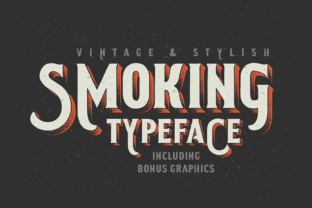
At first glance, Smoking Typeface lands firmly in the display font category. It is a serif font, but not the kind you would use for a dense novel or a corporate report. The serifs here are rugged, uneven in places, and full of texture. The letterforms carry a handmade quality—slightly distressed edges, subtle irregularities, and a weight that commands attention without feeling aggressive.
The personality sits somewhere between vintage signage and modern typography with a western soul. You can almost imagine it carved into wood, painted on glass, or stamped into leather. It has the confidence of something built to last, not manufactured to trend. That is the core appeal: Smoking Typeface feels authentic in a world saturated with sterile, mass-produced design.
It works best at larger sizes where its details can breathe. At smaller sizes, some of that texture might blur, so this is not a body text font. It is a premium font for moments that matter—headlines, titles, logos, badges, and anything that needs to stop a viewer mid-scroll.
Branding and Logo Design
If you are building a brand identity for a craft distillery, a barbecue joint, a leather goods shop, or an outdoor gear company, Smoking Typeface brings immediate character. It signals tradition, quality, and a no-nonsense attitude. Pair it with a clean sans serif font for body copy, and you have a brand identity that feels both grounded and approachable. The contrast between a rugged display font and a neutral sans serif creates visual hierarchy that guides the eye naturally.
Posters, Badges, and Event Graphics
Concert posters, festival branding, rodeo events, farmers market signage—projects like these live or die on atmosphere. Smoking Typeface delivers atmosphere in spades. Its weathered finish and western flavor make it a natural fit for badge designs, where you need a central word or name to feel iconic. A single word set in this font carries the weight of a whole story.
Packaging Design
Packaging is where fonts earn their keep. On a bottle of small-batch whiskey, a jar of handmade jam, or a box of artisanal crackers, Smoking Typeface communicates craft and care. It tells customers, without saying a word, that what is inside was made by someone who pays attention to details. That is the kind of brand perception you cannot fake with a generic typeface.
Invitations and Personal Projects
Weddings with a rustic theme, birthday parties, reunion invites, or holiday cards—these personal projects benefit from fonts that feel human. Smoking Typeface adds warmth and a touch of nostalgia without veering into cliché. It is a handwritten font in spirit, even if it technically falls into the serif category. The irregularities in the strokes make every word feel like it was written by a real person.
How Smoking Typeface Influences Readability and Engagement
Readability in a display font means something different than it does in a text font. You are not asking people to read paragraphs here. You are asking them to feel a word, a phrase, or a name. Smoking Typeface excels at that because its shapes are distinct and memorable. The letterforms do not blur together. Each character holds its own space, which is critical for logo design and short headlines.
Visual hierarchy becomes effortless when you use a font with this much personality. Put a headline in Smoking Typeface, keep your subheadings in a neutral sans serif font, and your body text in a clean serif font or sans serif font. The hierarchy is clear without any extra effort. The reader knows exactly where to look first.
Brand perception is where this font truly earns its place. A typeface is not decoration—it is the voice of your brand. Smoking Typeface says, We have been here. We know what we are doing. We value substance over flash. That message resonates with audiences who are tired of polished, generic branding. It builds trust because it feels honest.
Choosing Smoking Typeface for Your Project
Before you commit, ask yourself a few questions. Does your project benefit from a vintage or western atmosphere? Does it need to feel handmade, rugged, or authentic? Are you using it at a size where its details can be appreciated? If the answer is yes, you are on the right track.
Testing font pairing is essential. Smoking Typeface pairs well with simple, neutral companions. A clean sans serif font like a geometric or humanist style keeps the overall composition balanced. If you want something more traditional, a restrained serif font in a lighter weight can support the headline without competing. Avoid pairing it with another heavily stylized display font—you will end up with visual noise instead of clarity.
Check the included styles before you start. Smoking Typeface may come with multiple weights or alternates, and those extras can save you time when you need variation across a project. If you are working on web design, test the font at different screen sizes. It performs best at medium to large sizes, so plan your layout accordingly. For social media graphics, where every pixel counts, this font gives you instant personality in a crowded feed.
Licensing and Practical Considerations
Smoking Typeface is a commercial font, which means you need to check the license terms for your specific use case. If you are designing merchandise, product packaging, or digital products for sale, confirm that the license covers commercial use. Many creative font foundries offer standard desktop licenses, extended licenses for embedding in apps or websites, and enterprise licenses for larger teams. Read the fine print. It protects you and respects the work of the typeface designer.
For bloggers, content creators, and small business owners, a desktop license usually covers most needs—social media graphics, printed marketing materials, presentations, and digital ads. If you plan to use the font in a logo that becomes part of a registered trademark, some foundries require a separate license. Do not skip this step. Proper licensing is part of running a professional business.
For editorial design and publishing, Smoking Typeface works beautifully on covers, section openers, and pull quotes. It adds a tactile, grounded quality to magazines, zines, and book layouts. Just keep it limited to display use and let simpler fonts handle the body text.
For packaging design, consider how the font will reproduce on different materials. On textured paper, fabric, or embossed surfaces, Smoking Typeface looks even better because its ruggedness aligns with the physical medium. On glossy or metallic surfaces, the contrast between rough letterforms and smooth finish can be striking.
Final Thoughts from Practical Experience
I have worked with dozens of typefaces over the years, and the ones that stick are the ones with a clear point of view. Smoking Typeface has that. It is not trying to be a neutral workhorse. It is a character font, and characters earn their place by being memorable. If your project needs to stand out, feel authentic, and connect with an audience that values craftsmanship over convenience, this font belongs in your toolkit.
Treat it as a premium font asset—not because of the price, but because of the impact it delivers. Use it intentionally, pair it thoughtfully, and let it do the heavy lifting where it matters most: at the center of your message, where first impressions are made.