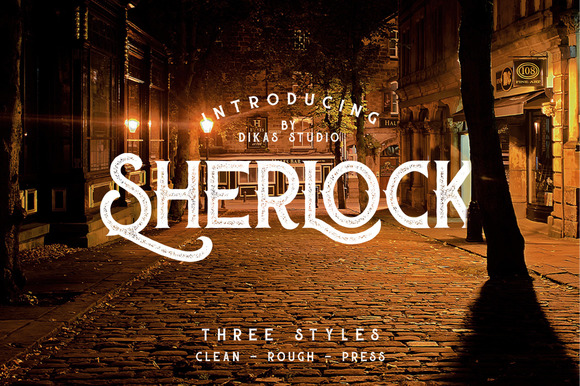
Sherlock: A Decorative Vintage Font With Three Distinct Personalities
Typography often serves as the silent narrator of a brand or project, setting the tone before a single word is read. Among the vast landscape of typefaces, Sherlock stands out as a decorative vintage font that wraps text in nostalgia while offering surprising versatility. Unlike many retro-style fonts that offer only a single weight or style, Sherlock is available in three distinct variations—Sherlock Regular, Sherlock Press, and Sherlock Rough—each bringing its own texture and mood. Whether you are a professional designer seeking an authentic period feel, a small business owner creating signage, or a hobbyist working on a personal project, understanding the nuances of these three variants can help you choose the right tool for your visual narrative.
What Makes Sherlock a Unique Vintage Typeface
At its core, Sherlock draws inspiration from lettering styles popular in the late nineteenth and early twentieth centuries—the era of gaslight, cobblestone streets, and hand-painted shop signs. The font captures the imperfect charm of metal type and woodblock printing, but it does so with enough polish to remain legible in modern contexts. The letterforms are slightly condensed, with pronounced serifs and gentle, rounded terminals that evoke a sense of craftsmanship.
What sets Sherlock apart from many other vintage fonts is its deliberate variety. Rather than offering a single interpretation of “old timey” design, the three variations allow you to choose the level of wear, texture, and contrast that best fits your application. This flexibility makes Sherlock suitable for everything from digital headlines to physical packaging and even fabric printing.
Understanding the Three Sherlock Variations
Each Sherlock variant has a distinct personality, yet they share enough structural DNA that they can be used together harmoniously. Let me break down what each variation offers and where it shines.
Sherlock Regular: Clean Vintage Elegance
Sherlock Regular is the most straightforward interpretation of the typeface. It retains the classic proportions and serif structure without adding any distressing or press effects. The strokes are crisp, the curves are smooth, and the overall impression is one of refined antique charm. This version works well when you want a vintage feel without sacrificing readability—for example, in longer passages of body text, book titles, or elegant invitations. Because it lacks overt wear, it also pairs nicely with modern sans-serif fonts, creating a subtle contrast that feels curated rather than costume-like.
One practical advantage of Regular is its performance in digital environments. On screens, where detailed distressing can become muddy, the clean lines of Sherlock Regular remain sharp even at smaller sizes. This makes it a solid choice for websites that need a touch of old-world character, such as craft marketplaces, heritage tourism sites, or online stores selling artisanal goods.
Sherlock Press: The Letterpress Effect
If you want to simulate the tactile impression of letterpress printing, Sherlock Press is the variation to use. The letters include subtle ink spread, slight misregistration, and a debossed shadow effect that mimics the way ink sits on thick paper. This variant is ideal for projects where you want the audience to feel the physical presence of the text, even if it exists only on a screen.
Designers often choose Sherlock Press for posters, merchandise mockups, and packaging where a handmade quality is paramount. The press effect adds depth without overwhelming the letterforms, and it pairs beautifully with textured backgrounds—think kraft paper, aged linen, or rough stone. For educators creating historical worksheets or reenactment materials, this variant instantly grounds the content in a specific period.
One observation from actual use: Sherlock Press performs best at medium to large sizes (around 24 points and above). At very small sizes, the press details can obscure the letters, so it is wise to reserve this variation for headlines, titles, and display text rather than footnotes.
Sherlock Rough: Grit and Character
Sherlock Rough leans further into imperfection with intentional distress marks, jagged edges, and uneven ink coverage. This is the most “vintage” of the three, evoking well-worn wood type that has been used for decades. The rough texture gives the lettering an immediate sense of history—as if it has been pulled from a dusty print shop or a weathered signpost.
This variant excels in projects that call for an edgy, lived-in aesthetic: horror movie posters, rustic restaurant menus, beer labels, and tattoo designs are all natural homes for Sherlock Rough. Because the distressed elements are bold, the font can hold its own over busy backgrounds or when printed on uncoated stock. Hobbyists and creators working on personal branding for handcrafted businesses often gravitate toward Rough because it communicates authenticity and grit.
However, legibility suffers if the text is reversed out (white on dark) at small sizes, so careful use of negative space is recommended. When used in all caps for a short word, the rough edges add a dramatic flair that cleaner fonts cannot replicate.
Practical Advantages of Using Sherlock
Beyond the aesthetic appeal, the Sherlock family offers several concrete benefits for a wide range of users.
- Versatility across media: Because the three variations are designed to work together, you can mix Regular for body copy, Press for subheadings, and Rough for the main headline—all while maintaining a cohesive look. This reduces the time spent searching for complementary fonts.
- Time-saving authenticity: Instead of manually adding noise or texture to a clean font, Sherlock Rough and Press give you instant distressed results. For designers who need to produce vintage-style work quickly, this is a productivity win.
- Broad applicability: From book covers and film credits to product labels and wedding stationery, the font adapts to both formal and informal contexts. Business owners, for instance, can use Sherlock Regular for a polished logo and then switch to Rough for limited-edition packaging to signal rarity.
- Licensing and availability: Many font families with multiple variations are expensive or restricted to specific use cases. Sherlock, depending on the foundry, often comes with a license that covers both personal and commercial projects, making it accessible to educators and hobbyists as well.
Use Cases and Real-World Applications
Let me walk through a few scenarios to illustrate how different users might leverage the Sherlock variants.
For Professional Graphic Designers
Imagine creating a poster for a theater production set in the 1890s. You could use Sherlock Regular for the actor names, Sherlock Press for the title phrase to mimic a playbill, and Sherlock Rough for the show dates to suggest a worn noticeboard. The combination tells a story without any additional graphic ornament. Designers also appreciate the font’s ability to retain character when scaled large—useful for banners or billboards where every pixel counts.
For Small Business Owners
A coffee roastery wanting to highlight its artisanal process might use Sherlock Rough on the primary bag label to convey handmade origins, then switch to Sherlock Press for a hang tag that lists flavor notes. The consistency across the product line builds brand recognition while the subtle textural differences keep each piece visually interesting. Similarly, a bakery offering “vintage-style” pastries could use Sherlock Regular on its website menu, reinforcing the old-fashioned theme without sacrificing readability on mobile devices.
For Educators and Researchers
History teachers creating classroom materials can employ Sherlock Press to give worksheets an archival look—without needing to simulate aging through filters. Researchers publishing articles on early printing methods might use Sherlock Regular for quotes from historical texts, using the distinctive serifs to visually separate commentary from modern analysis. The font acts as a subtle cue that these words belong to a different era.
For Hobbyists and Creators
Scrapbookers, calligraphy enthusiasts, and DIY crafters often seek fonts that add instant atmosphere. Sherlock Rough works well for stamping into clay or embossing on paper, while Sherlock Regular is clean enough for journaling. Because the font is decorative but still legible, it bridges the gap between art and function, which is exactly what many creative hobbyists need.
Considerations When Working With Sherlock
No font is perfect for every situation, and Sherlock has its own set of trade-offs worth noting.
Legibility at small sizes: As mentioned, the Press and Rough variants lose some clarity below 18 points. If you plan to use small body text, stick with Sherlock Regular or pair it with a simple sans-serif like Open Sans. Avoid using Rough for lengthy paragraphs or fine print.
Background complexity: The distressed details of Rough and Press can get lost on highly detailed backgrounds. A solid or lightly textured background is preferable. When using the font on a busy image, increasing the size or adding a subtle drop shadow may help the letters stand out.
Digital vs. print rendering: Sherlock Regular renders beautifully on screens, but the press and rough effects are more impactful in print where the reader can perceive the texture. If you are designing primarily for web, consider using Press or Rough only for hero sections or large headings, and rely on Regular for most other text.
Pairing with other fonts: Because Sherlock already carries a strong personality, it can overwhelm other typefaces if not balanced. A good rule of thumb is to pair it with a neutral, modern sans-serif (like Montserrat or Helvetica) for secondary text. Avoid pairing it with another decorative serif, which can create visual noise.
Observations on the Vintage Typography Trend
Sherlock’s rise in popularity parallels a broader cultural shift toward authenticity and nostalgia. Consumers increasingly gravitate toward brands that feel handcrafted and honest—a reaction against overly polished digital aesthetics. Sherlock taps into this sentiment not by being a perfect replica of a historical font, but by offering imperfections that feel intentional. The three variants give designers the control to dial the “vintage” up or down, which is especially useful when a client wants a nod to the past without looking dated.
In classrooms and studios, I have seen educators use Sherlock Press to teach students about the history of print technology—how ink spread and register mattered in the days of movable type. The visual cue helps abstract concepts become tangible. Similarly, small business owners find that using a font with genuine texture—rather than a gimmicky filter—helps their brand message land with more sincerity.
Perhaps the most compelling aspect of Sherlock is its ability to speak to multiple generations. Older audiences recognize the letterforms from old newspapers and signs, while younger audiences find the distressed look fresh and rebellious. That dual appeal is rare in a single font family and is a testament to how well the three variations were crafted.
Final Thoughts on Working With Sherlock
When approaching a project that requires a vintage or handcrafted feel, Sherlock offers a well-rounded toolkit. By choosing between Regular, Press, and Rough, you can calibrate the level of texture and wear to match your exact needs—whether that is a clean book title, a gritty poster, or a nuanced combination of both. The font does not claim to be a one-size-fits-all solution, but within its niche of decorative vintage typography, it delivers versatility that many similar typefaces lack.
Remember to test the variants at your intended sizes and on your final medium before committing. A quick print test or screen mockup will reveal whether the level of distress is appropriate. And do not be afraid to mix the variants in the same design; the family coherence ensures that even a two-variant composition feels together. With Sherlock, you are not just choosing a font—you are choosing a mood, an era, and a texture. And with three distinct paths to that mood, you have more creative freedom than most vintage typefaces provide.