Bohem Typeface Family: A Vintage-Inspired Font Collection for Authentic Design
Choosing the right typeface for a design project often comes down to finding a balance between visual character and practical function. Among the many font families available, Bohem and its associated Bohem Typeface Font Family offer a distinctive option for designers seeking an authentic vintage aesthetic. This article evaluates the family across several dimensions, helping you decide whether it aligns with your design goals.
What Is the Bohem Typeface Family?
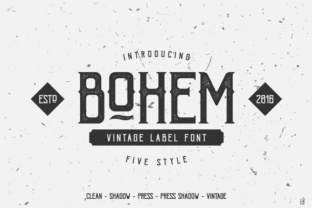
The Bohem Typeface Family is a curated collection of five fonts, each carrying the same core inspiration: the hand-lettered style of vintage beer brewery labels. The family includes Bohem Clean Regular, Bohem Shadow, Bohem Press, Bohem Shadow Press, and Bohem Vintage. Each variant builds on the same foundational letterforms while introducing different textures, depths, and ornamentation—ranging from clean outlines to pressed impressions and shadowed treatments.
The fonts support uppercase and lowercase characters, punctuation, numerals, multilingual characters, alternate glyphs, ligatures, and special symbols. This breadth of coverage makes the family more than a novelty font; it can serve as a practical tool for projects that demand a cohesive old-world feel across multiple design elements.
Why Designers Consider Bohem
Interest in Bohem typically arises from a need for authenticity in retro or heritage-themed work. Unlike generic "vintage" fonts that mimic roughness without depth, Bohem draws directly from the visual language of historical brewery labels—a context where lettering had to be both decorative and legible on bottles, kegs, and signage. Designers evaluating Bohem often fall into one of these categories:
- Branding professionals working with craft breweries, distilleries, or artisanal food products that want an immediate connection to tradition.
- Packaging designers who need a cohesive system of fonts (clean, shadow, press) for different levels of information on a label.
- Poster and signage creators aiming for a rustic, handcrafted look without resorting to distressed textures that can overwhelm a layout.
- Typography enthusiasts seeking a well-made family with OpenType features like ligatures and alternates that allow for customization.
The fact that Bohem provides five distinct styles within one family is a significant draw. Instead of hunting for separate fonts that may clash, you can use Bohem Clean for primary headlines, Bohem Shadow for emphasis, and Bohem Vintage for a weathered subheading—all while maintaining visual harmony.
Cohesive Vintage Aesthetic
The primary benefit is a unified design language. Each font in the family shares the same skeletal structure, so mixing them feels intentional rather than accidental. Bohem Clean offers the most legible form, while Bohem Press and Bohem Shadow introduce three-dimensional effects without distorting letter shapes. Bohem Vintage adds tactility through rough edges, and Bohem Shadow Press combines shadow and press for maximum depth. This range allows you to create hierarchy while preserving the vintage tone.
Rich Typographic Features
Beyond basic character sets, Bohem includes alternate glyphs and ligatures that mimic natural hand-lettering variation. For designers who want to avoid a repetitive, computer-generated look, these alternates can be swapped in to create unique wordmarks. The ligatures help certain letter pairs (like "Th" or "ff") flow more naturally, especially in larger display sizes. Multilingual support also extends usability beyond English-language projects, covering accented characters for many European languages.
Practical for Print and Digital
Despite its vintage inspiration, Bohem’s cleaner variants (Clean and Shadow) hold up well in digital contexts, provided they are used at appropriate sizes. The family is particularly effective for print materials such as bottle labels, coasters, merchandise tags, and banners. The press and shadow effects are designed to simulate physical printing techniques, which can reduce the need for additional Photoshop or Illustrator effects.
Tradeoffs and Considerations
While Bohem offers compelling strengths, it also comes with limitations that may affect its suitability for your project. Evaluating these tradeoffs honestly helps prevent misapplication.
Specialized Style May Limit Versatility
Bohem’s design is inherently specific. It strongly evokes pre-Prohibition era breweries, saloons, and apothecaries. If your project does not align with that historical reference point, the typeface can feel out of place. For example, using Bohem Vintage for a modern tech startup website would likely create a confusing visual message. The family excels when the brief explicitly calls for nostalgia, craftsmanship, or rustic charm.
Readability at Small Sizes
Fonts with high contrast, hand-drawn qualities, or decorative shadows may lose legibility when scaled down. Bohem Shadow and Bohem Shadow Press, in particular, introduce overlapping lines that can become muddy in body text or small captions. Bohem Clean Regular is the safest choice for smaller text, but even then, the font is best reserved for headlines, subheadings, and short bursts of copy rather than long paragraphs.
Alternate Characters Require Software Support
Accessing the alternate glyphs, ligatures, and special characters requires design software that supports OpenType features (such as Adobe InDesign, Illustrator, or Affinity Publisher). If you work primarily in simpler tools or web-based editors that lack OpenType control, you may not be able to use the full potential of the font. This is an important technical consideration before purchasing or licensing.
Where Bohem Excels as a Strong Fit
Based on its character set, style, and aesthetic, Bohem Typeface is a particularly strong choice in the following scenarios:
- Beer, cider, and spirits branding – This is the direct use case for which the font was designed. A craft brewery or distillery can use different variants for the logo, bottle labels, merchandise, and tap handles.
- Heritage and retro packaging – Products that want to convey artisanal quality, small-batch production, or a century-old recipe benefit from the visual shorthand that Bohem provides.
- Event posters for fairs, festivals, or markets – Especially those with a rustic or historical theme. Bohem Shadow works well for event dates, while Bohem Vintage adds texture to background text.
- Signage with a handcrafted feel – Bar menus, chalkboard-style signs, and pub decor can use Bohem Clean for readability at a distance and Bohem Press for depth on specials.
- Logos and wordmarks for small businesses – Bakeries, butcher shops, coffee roasters, and other artisanal enterprises can develop a cohesive identity using just one Bohem variant as their base.
In these contexts, the typeface does more than decorate—it supports brand recognition by tapping into cultural associations of quality and tradition.
When Alternatives Are Worth Considering
No single typeface fits every project. You may want to explore alternatives if your needs fall outside Bohem’s sweet spot.
- Modern or minimalist designs – If your brief requires a clean, neutral sans-serif that stays in the background, Bohem’s personality will be too strong. Consider families like Montserrat, Open Sans, or Roboto for unobtrusive versatility.
- High-legibility body text – For long articles, reports, or user interfaces, a text-focused serif or sans-serif with even stroke widths and generous x-heights is preferable. Bohem Clean, even at its cleanest, maintains a hand-drawn quality that can be tiring to read in bulk.
- Extreme multilingual coverage – While Bohem supports many European languages, it may lack glyphs for Central European, Cyrillic, Greek, or Asian scripts. If your project requires broad internationalization, look for fonts with extended language support.
- Overused vintage styles – Because the “brewery label” look has become popular in craft branding, some audiences may find it too familiar. If you need a fresh take on retro without the typical saloon vibe, you might consider a different ornamental or display typeface with a more subtle reference.
Practical Decision-Making Insights
Before committing to Bohem for a project, consider the following questions to evaluate fit:
- What is the core message of your design? If authenticity, heritage, and craftsmanship are central, Bohem supports that message naturally. If efficiency, innovation, or minimalism are key, it likely works against you.
- Who is your audience? Audiophiles, beer enthusiasts, or locals at a pub will read the historical cues positively. Corporate clients or audiences expecting a sleek modern look may perceive it as outdated.
- How will the fonts be used across media? If you need both large headlines and small disclaimers, test Bohem Clean at the smallest required size. If you need layered effects, see how Bohem Shadow Press holds up against dark backgrounds.
- Can you access the full OpenType features? If your workflow is in web-only tools that ignore alternates and ligatures, you may lose the very customization that makes Bohem valuable. In that case, you might only be getting the basic character set, which weakens the investment.
- Does the family provide enough variety for your project? The five styles offer considerable range, but they are all variations on the same theme. If your identity requires a stark contrast (e.g., a formal serif paired with a modern sans), Bohem may not be the right starting point.
For many designers, the best approach is to use Bohem as a display element and pair it with a neutral companion typeface for body copy. This allows the vintage character to shine where it matters without overwhelming readability. A clean sans-serif or a simple serif in the same weight can balance the ornamentation of Bohem Shadow or Bohem Vintage.
Final Considerations
The Bohem Typeface Family sits squarely in the niche of decorative, historically-inspired display fonts. It is not a general-purpose workhorse, nor does it claim to be. Its value lies in the cohesive system of five styles that can quickly establish a strong thematic identity—especially when that identity is rooted in the aesthetics of early 20th-century brewing and trade lettering.
If your project demands visual authenticity, careful layering of vintage textures, and a typographic system that works across headlines, subheads, and decorative accents, Bohem deserves serious consideration. However, if your requirements include extreme versatility, high legibility at small sizes, or a modern visual language, exploring more neutral alternatives will likely serve your goals better.
As with any design asset, the key is to match the typeface’s inherent character to the project’s context and audience. Evaluate Bohem not just on its aesthetics, but on how its specific voice aligns with the message you need to communicate. When applied with intention, it can be a powerful tool for creating designs that feel both crafted and credible.