Bartolomew: A Monoline Handwritten Font That Bridges Retro and Modern Design
If you have ever scrolled through font libraries looking for something that feels personal without being overly decorative, you have likely noticed how hard it is to find a typeface that balances character with readability. Many handwritten fonts lean too far into embellishment, making them difficult to use in anything beyond a logo or a short headline. Others play it so safe that they lose the warmth and personality that drew you to handwritten typography in the first place. Bartolomew sits in a refreshing middle ground. It is a monoline handwritten font designed for display use, but it reads cleanly enough to work in longer passages and across a wide range of projects. Whether you are building a brand from scratch, designing packaging, or putting together a personal zine, this typeface offers a cool, understated voice that fits both retro and contemporary aesthetics.
What Makes Bartolomew Different from Other Handwritten Fonts
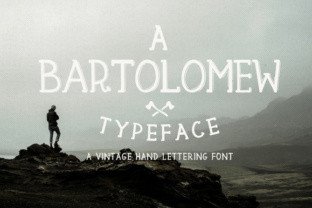
The term monoline refers to the consistent stroke thickness throughout each letter. Unlike brush scripts or calligraphic fonts where pressure variations create thick and thin lines, Bartolomew maintains an even weight across every character. This gives it a clean, modern appearance while still preserving the natural irregularities that make handwriting feel human. Each letterform has a relaxed rhythm, as if written with a steady hand and a quality pen. The result is a font that feels intentional but not stiff, casual but not sloppy.
Another defining characteristic is its versatility across design contexts. Bartolomew does not commit strongly to any single era. You can pair it with vintage-inspired color palettes and textures to evoke a mid-century diner menu or a 1970s paperback cover. At the same time, it sits comfortably next to minimalist layouts, sans-serif headers, and muted gradients that define modern digital branding. This duality makes it especially valuable for creators who work across multiple styles or who want a font that can evolve with their projects over time.
For beginners who are just starting to explore typography, Bartolomew is an approachable choice. It does not require you to master complex pairing rules or understand advanced kerning tricks. The font reads well at various sizes, from small subheadings to large display text, and its monoline nature means it reproduces clearly on screens and in print without losing detail. If you have ever felt intimidated by highly stylized scripts that demand careful spacing and precise sizing, this font offers a more forgiving entry point.
How Creators and Professionals Can Use Bartolomew in Real Projects
One of the most practical applications for Bartolomew is in branding and identity work. Small business owners, freelancers, and entrepreneurs often need a logotype or wordmark that feels personal without looking generic. Using this font as the primary text for a brand name can convey approachability and authenticity, especially for businesses in creative fields, hospitality, wellness, or handmade goods. Imagine a coffee shop logo, a freelance illustrator's website header, or the packaging for a small-batch skincare line. In each case, Bartolomew adds a human touch without sacrificing professionalism.
Bloggers and content creators can use Bartolomew for social media graphics, video titles, and newsletter headers. Its readability at medium sizes makes it suitable for Instagram quotes, Pinterest pins, or YouTube thumbnail text where clarity is essential. Because the font has a friendly but not overly cute personality, it works well for lifestyle, travel, and educational content. You can pair it with a simple sans-serif body font to create a cohesive visual system that feels curated but not complicated.
Educators and hobbyists will find Bartolomew useful for printable materials such as worksheets, flashcards, posters, and presentation slides. Its clean lines ensure that students can read the text easily, while the handwritten quality adds a sense of warmth that standard classroom fonts lack. If you create digital products like planners, journals, or sticker sets, this font can give your designs a cohesive handwritten aesthetic across multiple pages or items. The monoline stroke also means the text remains readable when reduced in size for margins or footnotes.
For personal projects, the possibilities are even broader. You might use Bartolomew to design invitations for a wedding, birthday, or dinner party. It works well for custom T-shirt graphics, handmade greeting cards, or even a personal letterhead. Because the font feels cool and contemporary without being trendy in a way that will date quickly, it is a solid investment for projects that you want to feel current for years to come.
Why Bartolomew Appeals to Both Retro and Modern Design Sensibilities
There is a reason so many designers seek out fonts that sit at the intersection of old and new. Pure retro fonts can feel like costumes, while purely modern fonts can feel cold. Bartolomew avoids both extremes. Its letterforms have a nostalgic quality that recalls handwritten signs, vintage packaging, and mid-century ephemera, but the monoline construction keeps it grounded in contemporary minimalism. You can use it on a beige background with distressed textures for a worn-in look, or on a bright white screen with bold geometric shapes for a clean, modern feel. The same font can anchor entirely different visual identities depending on the supporting elements you choose.
This flexibility is especially helpful for marketers and small business owners who manage their own design work. You might not have the budget or time to switch fonts every season or for every campaign. Having a single display font that adapts to different moods and themes simplifies your workflow and keeps your brand consistent. Bartolomew also pairs well with a wide range of accent fonts and decorative elements, so you can experiment without worrying about clashing styles.
Important Considerations Before Using Bartolomew
While Bartolomew is versatile, it is still a display font at heart. That means it shines brightest at medium to large sizes. For very small text, such as body copy in a multi-paragraph article or fine print on a product label, the handwritten details can become less distinct, and readability may suffer. If you need a font for long-form reading, plan to pair Bartolomew with a clean, readable body typeface rather than relying on it alone. A simple sans-serif like Open Sans, Lato, or Montserrat tends to complement its handwritten character without competing for attention.
Another factor to keep in mind is licensing. As with any font used in commercial or client work, be sure to check the specific license terms for Bartolomew. Some fonts restrict usage in certain contexts, such as merchandise for sale or digital products distributed to customers. Understanding the license upfront saves you from legal headaches later and ensures that you can use the font confidently across all your projects.
If you are new to working with handwritten fonts, take a little time to experiment with spacing and sizing. Monoline fonts like Bartolomew often benefit from generous letter spacing in larger display settings, while tighter spacing can feel more natural for smaller text. Try a few variations before settling on a final arrangement, especially for logo work where every detail matters. Testing the font in different colors and on different backgrounds also helps you see how it behaves in various contexts before you commit.
Getting Started with Bartolomew in Your Own Projects
If Bartolomew sounds like a good fit for your next design, start by downloading the font and installing it on your system. Open your design software of choice and create a few test compositions. Try writing your business name, a short quote, or a product headline in the font and experiment with sizing, spacing, and color. See how it looks on its own and how it interacts with other visual elements like icons, borders, and images. The more you play with it, the more you will develop an instinct for where it works best.
Consider creating a simple brand board or style tile that uses Bartolomew as the display font alongside a secondary body font, a color palette, and any textures or patterns you plan to use. This gives you a reference point that keeps your designs consistent and saves time when you need to produce new materials. Over time, you might find that Bartolomew becomes one of those fonts you return to again and again, not because it is flashy or trendy, but because it is reliable, readable, and quietly cool.
For those who enjoy pushing creative boundaries, try using Bartolomew in unexpected places. Pair it with bold geometric borders for a contrast between organic and structured. Layer it over photography for editorial-style layouts. Use it as the primary text for a short-run publication or a personal blog header. The monoline handwritten style invites experimentation, and because it is not overly ornate, even unconventional combinations tend to look intentional rather than chaotic.
Whether you are a seasoned designer looking for a fresh alternative to the usual script fonts, or a beginner taking your first steps into typography, Bartolomew offers a compelling mix of personality and practicality. It meets you where you are, adapts to your style, and gives your work a distinctive handwritten voice that stands out without shouting. That balance is harder to find than most people realize, and it is exactly what makes this font worth adding to your toolkit.